
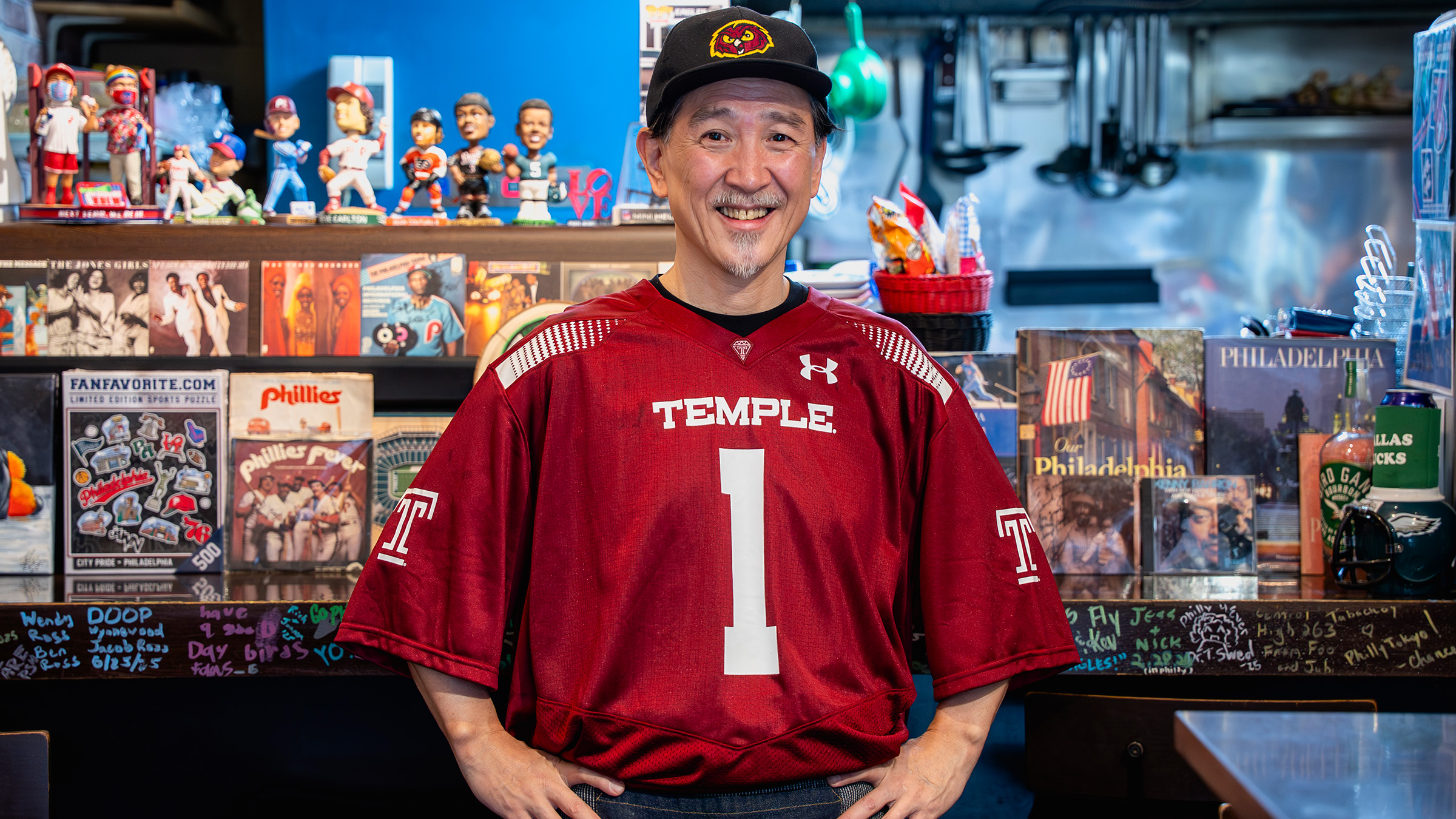
Kosuke Chujo, master of Nihonbashi philly, poses in Temple football gear and a Temple cap inside his shop.
Watch a Video:
In a quiet corner of Tokyo’s historic Nihonbashi district, the soul of Philadelphia is sizzling on a hot griddle. At Nihonbashi philly, a compact cheesesteak shop tucked between traditional storefronts, owner Kousuke Chujo serves sandwiches so faithful to the Philly original that Temple University students swear they can taste Broad Street in every bite.
In early October, a group of students and staff from Temple University, Japan Campus (TUJ) visited Nihonbashi philly to taste its food and interview the owner, Kousuke Chujo, before the shop opened for the day. During the visit and filming around noon, several foreign guests, including visitors from Philadelphia, stopped by to view the shop and take photos in front of it, even though it opens only from 6 pm, indicating its growing recognition among international tourists.
Chujo has visited Philadelphia many times to experience the city’s iconic cheesesteaks, particularly since 2020, around the start of the pandemic, when he decided to focus on creating a truly authentic version of the sandwich in Tokyo. He recalls that these visits were not only important for learning about the food itself but also for building relationships with the local community in Philadelphia.
Pandemic Becomes a Turning Point
He said the turning point came during the pandemic, when many neighboring shop owners near Nihonbashi philly decided to close their businesses due to the uncertain future. Chujo found himself reflecting deeply on what he really wanted to do with his business and with his life.
Chujo comes from a family whose grandparents ran a printing factory in Nihonbashi. In 2011, he decided to close the factory and open an izakaya-style restaurant in its place. He named the restaurant after his love for Philadelphia soul music and artists from the legendary Philadelphia International Records label.
When he first opened the restaurant, Chujo wanted to serve classic American dishes such as steaks, sandwiches, and hamburgers, but it wasn’t easy. Over time, he expanded his menu to include a wider variety of food. Having played rugby in his youth, he attracted many rugby friends and fans as customers, especially as Japan prepared to host its first Rugby World Cup in 2019.
The shop was doing well and had built a loyal customer base, but soon after the tournament, the pandemic hit.
“Back then, I was thinking really hard and asking myself over and over, ‘Is this what I really want to do?’” Chujo recalled. “I knew the answer was no. I wanted to open a pure American-style restaurant serving food like cheesesteak, something that connects to Philly soul music, which inspired the name of my shop.”
More Cheesesteaks, Stronger Friendships
In 2020, Chujo and his wife traveled to Philadelphia, visiting around 30 cheesesteak shops within about a five-kilometer radius of Center City. They also met with local bakers who supplied bread to many of the city’s most famous cheesesteak shops. Since then, they’ve returned to Philadelphia every year, sampling more than 100 cheesesteak shops, including large chains, neighborhood favorites and those in North Philadelphia near Temple.
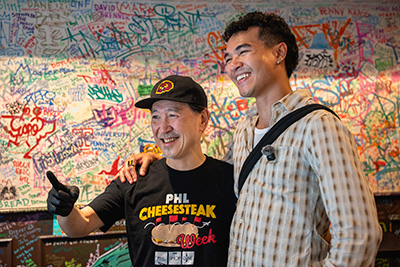
“After coming back from Philadelphia that first year 2020, we received great feedback from customers saying our cheesesteak was good, but I was still skeptical,” Chujo said. “So we went back again and again, tasting different styles and learning from each place. Not only did we improve our cheesesteak, but we also built strong friendships with people in Philadelphia.”
As Chujo refined his recipe, Nihonbashi philly began attracting more and more customers, locals, tourists from the U.S. and fans of Philadelphia’s professional sports teams such as the Eagles, Phillies, Flyers, and Sixers. Many American visitors, including students and alumni of universities like Temple, UPenn and Villanova, have found the shop’s taste and atmosphere both nostalgic and authentic.
Deepening Ties with Temple
The shop is filled with memorabilia, uniforms, caps, and merchandise from Philadelphia’s sports teams and universities, including Temple. Customers often leave messages and doodles on the walls and tables, many of them praising the food and thanking Chujo for bringing a taste of Philly to Tokyo.
“I can easily tell that Temple University is everywhere in Philadelphia, it’s part of the city and the community,” Chujo said. “Because I decided to follow what I truly wanted to do by opening an authentic cheesesteak shop, I’ve been able to meet so many Temple students, faculty and alumni. Many of them, both from Philly and other parts of the U.S., say it reminds them of home.”
Chujo also sees similarities between Philadelphia and his hometown of Nihonbashi. “People in Philadelphia were so kind and welcoming when we visited their cheesesteak shops and bakeries,” he said. “Everyone worked hard to serve good-quality food with care, and I learned a lot from them. I feel the same kind of warmth from Temple students, too.”
Parallels Between Philadelphia and Nihonbashi
He added that both cities share a deep historical and cultural heritage with Philadelphia as the birthplace of American independence and Nihonbashi as a traditional center of Tokyo where many elements of Japanese food culture, including sushi, originated.
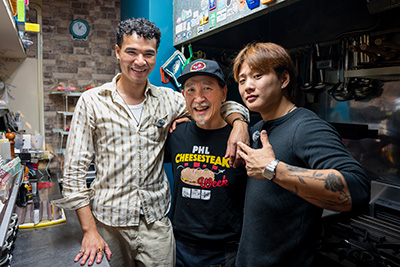
Temple students are now regular customers at Nihonbashi Philly and Chujo has even hired TUJ students to work at his shop in the past.
During this visit, TUJ’s communications and social media staff were joined by two students, Sean McClendon, a study-abroad student from Temple’s Main Campus, and Sora Abe, an economics major at TUJ, who both enjoyed Chujo’s cheesesteak.
McClendon said he was impressed by the dedication of Chujo and his wife to making an authentic Philly cheesesteak, noting that Chujo studied well-known spots in Philadelphia and that his wife bakes the bread.
“So saying it was very authentic and really good wasn’t an understatement,” McClendon said. “He put in the time and effort to reach that level, and you can taste it. I really felt at home in a lot of ways, especially with all the Temple records and Philly references covering the walls. It felt warm, comfortable and really fun. He was great to talk to. I definitely want to go back, talk more with him, and bring some of my friends to try the food.”
Other related stories
- “Tempura Uni.” T-Shirts Connect Temple University Students and Setagaya Community in Growing Cultural Exchange (August 27, 2025)
- TUJ Students Celebrate Community Spirit at 100th Kifune Matsuri Festival in Tokyo: Photo Gallery and Video (June 20, 2025)
- Temple University Jazz Band Swings into Japan, Jams with Waseda University and Engages TUJ Community at Top Tokyo Club (March 24, 2025)