




Blog

  • Temple University Japan Opens Hillside Center, Expanding Presence in Tokyo Region

    Temple University Japan Opens Hillside Center, Expanding Presence in Tokyo Region

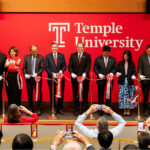
    Temple University Japan leaders and distinguished guests participate in the ribbon-cutting ceremony at the new Hillside Center.

    • Hillside Center expands Temple University’s presence in Tokyo metropolitan area
    • More than 300 guests, including Kawasaki City’s mayor, celebrated the opening
    • Hillside showcases new facilities as TUJ enrollment nearly triples in last five years

    Temple University Japan (TUJ) has reached another major milestone in its continued growth with the opening of the Hillside Center, its second major location in the Tokyo metropolitan area. Designed primarily to serve first-year students and support general education courses in the liberal arts and STEM fields, the new center further strengthens TUJ’s academic presence and capacity in the region.

    More than 300 distinguished guests attended the Hillside Center’s grand opening ceremony on September 4, 2026, at the new 7,000-square-meter academic building in Mizonokuchi, Kawasaki City. The opening marks TUJ’s latest expansion in the Tokyo region, less than two years after the opening of TUJ Kyoto in January 2025. The Hillside Center is easily accessible from TUJ’s City Campus in Setagaya City, creating a closely connected network of facilities to serve Temple University’s growing student community.

    The opening ceremony began with remarks from Kacie Levinton, head of the Hillside Center. TUJ President and Dean Matthew Wilson delivered the welcome address. Congratulatory speeches were delivered by distinguished guests, including Norihiko Fukuda, Mayor of Kawasaki; Kaori Furuya, Deputy Director of the International Affairs Division of the Higher Education Bureau at the Ministry of Education, Culture, Sports, Science and Technology (MEXT); and Erik Jacobs, Chief of Staff for the U.S. Ambassador to Japan George E. Glass.

    “The Hillside Center marks an exciting new chapter in Temple University’s commitment to providing an exceptional American education in Japan,” Wilson said. “As our newest location, Hillside reflects Temple University Japan’s continued investment in academic excellence, innovation and student success. Building on over four decades as a bridge between Japan and the world, we invite students, families and friends to discover the educational opportunities and global experiences that make our institution a distinctive place to learn, grow and prepare for the future.”

    Opening Ceremony Highlights Hillside’s New Facilities

    Temple University students led campus tours for guests, showcasing the newly renovated academic facility and its 23 modern classrooms with hybrid learning technology, 300-seat auditorium, multiple study lounges and rooftop gardens. The opening celebration also featured a ribbon-cutting ceremony, musical performances and a time capsule ceremony.

    Items placed in the time capsule, which will be opened to commemorate TUJ’s 60th anniversary in 2042, included messages written on special postcards created for the event, Philadelphia Phillies items from Temple University’s home city, items commemorating the 250th anniversary of the United States from the U.S. Embassy, a soccer kit provided by the mayor of Kawasaki and newspaper articles covering the opening of the Hillside Center.

    Temple University’s sustained efforts to advance high-quality English-language international education in Japan have attracted an increasingly diverse student body from Japan, across Asia and from around the world.

    Expansion, Enrollment and New Programs

    The expansion comes during one of the most dynamic periods in Temple University Japan’s nearly 45-year history in Japan. To accommodate its rapidly growing student body, TUJ has expanded its facilities to support students’ academic and personal well-being while adding faculty and developing new curricula to meet evolving academic needs.

    As part of this academic expansion, TUJ began offering two new undergraduate majors — artificial intelligence and cybersecurity — in fall 2026. The new programs, together with the Hillside Center, reflect TUJ’s continued investment in preparing students for emerging fields and expanding opportunities for an increasingly international student population.

    Along with enrollment growth, TUJ has continued to expand its partnerships with universities in Japan and overseas, as well as with municipal governments and public organizations. TUJ currently has eight Japanese municipal partnerships and four Japanese university partnerships.

    TUJ is a branch campus of Temple University, one of only 21 universities in the U.S. to hold both the highest research rating of Research-1 (R1) status and the Opportunity College and University designation in the 2025 Carnegie Classifications.

    The university continues to broaden its undergraduate and graduate offerings. TUJ also offers non-degree programs to more than 2,000 learners of all ages, with a community focus on advancing English-language education from youth through adulthood.


    Other related news

  • Beyond the University Classroom: Temple Expands Learning Opportunities Across Japan

    Beyond the University Classroom: Temple Expands Learning Opportunities Across Japan

    High school students from Nagasaki and Ehime explore the scientific method in an English-only classroom at TUJ Kyoto

    Summer brings a different kind of energy to Temple University Japan (TUJ). More than 1,400 students, from elementary school through college, participate in summer intensive programs offered by TUJ’s Academic English Program (AEP) across Tokyo and Kyoto.

    The programs reflect an important part of TUJ’s role in Japan: working with schools, boards of education and local governments to expand English and international learning opportunities for young people.

    In August 2026, nearly 50 high school students from Nagasaki and Ehime prefectures came to TUJ Kyoto for a four-day program developed with their respective boards of education. The program grew out of TUJ’s comprehensive partnership agreements with the two prefectures to create new educational opportunities for young people in their communities.

    High school students give a presentation on the final day of the program.
     Temple graduate student Joshua Corrales supports students during a classroom activity.
    Students conduct an experiment as part of a classroom activity.

    Learning English by Learning in English

    AEP goes beyond simply studying English. Guided by experienced instructors with professional backgrounds in TESOL and English language education, students use English to explore ideas, communicate with others and learn from different perspectives. Over four days, the students explored topics including science, economics and critical thinking through group work, discussion and problem-solving. Students from different schools, grade levels and English backgrounds worked together, with groups changing throughout the program to create more opportunities to communicate with new people.

    The approach gives younger learners an opportunity to experience the kind of interactive, student-centered learning they might encounter in an American university classroom.

    Connecting Temple Across Campuses and Classrooms

    This summer, AEP’s professional teaching team was joined by Dr. Jill May Swavely and four graduate students from Temple University’s TESOL program in Philadelphia. They spent approximately three weeks at TUJ Kyoto, supporting AEP students while gaining hands-on experience in a different educational and cultural setting.

    Temple professor and TESOL graduate students who joined the AEP teaching team at TUJ Kyoto. From left: Joe Courtney, Dr. Jill May Swavely, Cameron Coleman, Joshua Corrales and Leo Li.

    The graduate students brought perspectives from different educational backgrounds. Joshua Corrales first studied at TUJ as an undergraduate in 2014 and later taught high school students in Hokkaido through the Japan Exchange and Teaching (JET) Programme. Joe Courtney teaches ESL in Philadelphia, Leo Li previously taught high school students in Taiwan, and Cameron Coleman came to TESOL through her work with international students at Temple. TUJ Kyoto undergraduates also participated after receiving training as teaching assistants, supporting group work and communication in the classroom.

    For the Temple graduate students, working with Japanese students also offered a different perspective on English language education. Swavely explained that ESL educators in the United States often work with immigrants, refugees and other learners who need English for everyday life. In Japan, students typically learn English as a foreign language, creating a different context for both teaching and learning. Swavely noted that this was the first time graduate students from Temple’s TESOL program in Philadelphia had participated in this kind of practicum at TUJ.

    “Watching our graduate students engage with Japanese students, learn from them and make their own discoveries was incredibly meaningful,” she said. “It was an important experience for Temple as well.”

    Opening New Possibilities

    Students and the AEP teaching team celebrate the completion of the four-day program at TUJ Kyoto.

    By the final day, students who had arrived as strangers were exchanging ideas and building new connections. Some talked about wanting to study more English, attend university in the United States or even study at Temple.

    Through programs like AEP and partnerships with schools, boards of education and local governments, TUJ creates opportunities for young people to learn, connect and explore what comes next. Eligible high school students from Nagasaki and Ehime can also apply for the TUJ Partnership Scholarship (Japanese), which provides 50% tuition support for their first two semesters at TUJ. That connection can extend beyond graduation. Nearly 70% of TUJ’s international undergraduate students stay in Japan after graduation to work or continue their studies, extending their connection with Japan beyond their time at Temple.


    Other related stories

  • Experience the World in Japan – 80 Osaka Prefectural High School Students Join International Discussions at TUJ Kyoto

    Experience the World in Japan – 80 Osaka Prefectural High School Students Join International Discussions at TUJ Kyoto

    TUJ Kyoto brings together Osaka high school students and TUJ students for English-language discussions on overtourism.

    • With students from more than 90 countries and regions, Temple University Japan has one of Japan’s most international learning environments
    • In TUJ’s international environment, high school students from Osaka explored the real-world challenge of overtourism through English-language discussions.
    • Temple University Japan students served as facilitators and mentors, putting their global leadership skills into action
    • Participants built skills beyond the classroom including cross-cultural communication, critical thinking, and intercultural skills through collaborative problem-solving
    • Program implemented through TUJ’s partnership agreement with the Osaka Prefectural Board of Education

    On July 18, 2026, Temple University Japan (TUJ) Kyoto hosted the “High School International Conference 2026” in collaboration with the Osaka Prefectural Board of Education. Approximately 80 students from Osaka Prefectural high schools joined about 40 TUJ students to discuss, entirely in English, the issue of overtourism facing Japan’s popular tourist destinations.
    Rather than simply practicing English, students experienced the kind of collaborative, discussion-based learning that defines a Temple education. Guided by TUJ student facilitators, they examined real-world issues, exchanged diverse perspectives, and worked together to develop practical solutions.
    With students representing more than 90 countries and regions, TUJ offers one of Japan’s most internationally diverse learning environments. The student facilitators participating in this program represented 18 countries and regions, with approximately 45 percent from the United States. Others came from Japan, Vietnam, Tanzania, Mongolia, Germany, Brazil, Saudi Arabia, China, and many other countries.
    In this international setting, TUJ provided high school students with an authentic global learning experience, exposing them to different varieties of English, cultural perspectives, and ways of thinking.

    Who Is a Tourist?

    Three TUJ student workers giving a presentation in front of high school students.
    TUJ students and high school students from Osaka get ready to exchange ideas in group discussions.

    TUJ’s classes encourage students to think critically by starting with questions and discussion.
    Associate Dean William Swinton opened the session by asking a simple question:
    “Who is a tourist?”
    He then followed with another question:
    “You traveled from Osaka to Kyoto today. Does that make you tourists?”
    Swinton, who was born in New York, has lived in Japan for more than 20 years and now resides in Kyoto. He then smiled and asked,
    “Do you think I am a tourist?”
    Most of the high school students shook their heads. Through these questions, TUJ introduced the high school students to its inquiry-based approach to learning, encouraging them to think through questions and deepen their understanding through dialogue. The discussion also encouraged students to recognize that they themselves can be tourists and to move beyond fixed assumptions as they explored overtourism and its impact from multiple perspectives.

    Fourteen Groups, One Language: English

    Participants were divided into discussion groups, each consisting of high school students and two or three TUJ student facilitators.
    These TUJ students served as Teaching Assistants in the Academic English Program (AEP) and drew on the facilitation skills they had developed through their training. They encouraged hesitant participants, guided discussions, and helped every student feel confident sharing ideas in English.

    Student Proposals for Sustainable Tourism

    The discussions focused on challenges associated with overtourism and explored ways local communities and visitors can coexist more sustainably. The high school students recognized that everyone becomes a tourist when traveling, and guided by our TUJ students they considered multiple perspectives and learned to think more critically about possible solutions.

    A “Study Abroad at Home” Experience

    By the end of the afternoon, many students who had initially been hesitant to speak English were confidently sharing their ideas with classmates.
    Over the course of just three-and-a-half-hours, participants experienced firsthand how different perspectives can lead to deeper discussions and more creative approaches to solving real-world challenges.

    TUJ student facilitators who supported small-group discussions throughout the conference.

    Learning with the World at Temple University Japan

    Every day at Temple University Japan, students from more than 90 countries and regions learn with and from one another while tackling real-world issues. The program gave local high school students a glimpse of what it is like to study at Temple University Japan while providing TUJ students with an opportunity to put their leadership, communication, and facilitation skills into practice through meaningful community engagement.

    A Growing Partnership for Global Education

    Temple University Japan (TUJ) and the Osaka Prefectural Board of Education signed a partnership agreement in 2024 and have since worked together to advance a range of educational programs for high school students and teachers. This event marked the first program for Osaka Prefectural high school students under the partnership. The collaboration continues to expand, including professional development programs for English teachers at Osaka Prefectural high schools this summer. TUJ will continue to work with the Osaka Prefectural Board of Education to provide high-quality learning opportunities for students and teachers and contribute to the further development of international education.


    Other related stories

  • Temple University Japan Appoints Two Renowned Scholars as Special Presidential Advisors and Board of Overseers Members

    Temple University Japan Appoints Two Renowned Scholars as Special Presidential Advisors and Board of Overseers Members

    TUJ appoints Yukari Sato (left) and Sachio Semmoto (right) as special advisor to the president.

    • TUJ appoints Sachio Semmoto and Yukari Sato as special advisors to the president, honorary professors and Board of Overseers members
    • Semmoto and Sato bring expertise spanning technology, economics, academics and public service
    • Appointments strengthen TUJ’s commitment to innovation and global engagement

    Temple University Japan (TUJ) has named renowned telecommunications pioneer Sachio Semmoto and distinguished economist and former Japanese legislator Yukari Sato as special advisors to President Matthew Wilson and honorary professors. In addition, Temple University has appointed both to TUJ’s Board of Overseers.

    Bringing decades of leadership and experience in technology, economics, public policy, and higher education, Semmoto and Sato will help advance Temple University’s strategic priorities, strengthen its academic mission, and deepen its engagement with industry, government and the global community in Japan and Asia.

    Temple University is experiencing one of the most dynamic periods in its 45-year history in Japan. As TUJ’s enrollment continues to reach record highs, the university has broadened its academic offerings, while expanding its faculty, staff and campus facilities. Temple Japan opened TUJ Kyoto in January 2025 and is preparing to open the Hillside Center, its second major academic location in the Tokyo metropolitan area, in Kanagawa Prefecture in August 2026.

    Through these key leadership and advisory roles, Sato and Semmoto will provide strategic insight into institutional growth, innovation, and global partnerships, further strengthening TUJ’s position as a bridge between Japan and the international community.

    These appointments underscore TUJ’s commitment to advancing student success, international education, and cross-cultural exchange. They follow the appointment of Sergiy Korsunsky, former Ukrainian ambassador extraordinary and plenipotentiary to Japan, as special advisor to President Wilson in July 2025.

    Acclaimed Financier and Lawmaker

    Sato is the president and CEO of Future Analytics, Inc. and has over 20 years of experience in the Liberal Democratic Party and served 16 years in the Japanese Diet. She held multiple state minister positions during the administration of Prime Ministers Shinzo Abe and Yoshihide Suga including State Minister of the Cabinet, State Minister of the Environment, and State Minister for Internal Affairs and Communications. She is also an outside board director for Hosokawa Micron Corporation, Sentient K.K. and SRS Holdings.

    She holds a doctoral degree in economics from New York University and a master of international affairs from Columbia University School of International and Public Affairs. Additionally, she has taught at various universities, including Temple University Japan, Kwansei Gakuin University, and Chuo University.

    Pioneer of Japan Telecom Industry

    Semmoto is co-founder of Daini-Denden (DDI), the parent company of KDDI Corp., and one of Japan’s most influential telecommunications entrepreneurs and a pioneer of the country’s mobile communication industry. Through his creation of eAccess and eMobile, Semmoto helped expand mobile connectivity and broadband infrastructure across Japan.

    In 2023, Semmoto founded AI Biomedical Inc. and Quality Cloud Corp., where he serves as chairman. He has also served as an outside board member of several world-class companies, including NetApp, Reuters and Telecom New Zealand.

    A graduate of Kyoto University, Semmoto earned a doctorate in electrical engineering from the University of Florida. He has served as a professor at Keio University and held academic appointments at leading institutions, including the University of California, Berkeley; Carnegie Mellon University; and Stanford University. He also founded the Frances and Sachio Semmoto Foundation to bridge the worlds of technology, entrepreneurship, and education.


    Other related stories

  • TUJ Deepens Partnership With India; President Wilson Highlights Four Intelligences for AI-Era Education

    TUJ Deepens Partnership With India; President Wilson Highlights Four Intelligences for AI-Era Education

    TUJ President and Dean Matthew Wilson (center) speaks during a panel discussion involving top university leaders at the India-Japan Higher Education Forum in Tokyo.

    • TUJ expanded its partnership with India’s JGU through its second Kyoto summer program
    • TUJ President Wilson joined leaders from top universities in Japan at major forum on artificial intelligence and higher education
    • Wilson emphasized that universities must cultivate AI, real intelligence, global intelligence and practical intelligence to prepare future leaders

    Temple University Japan (TUJ) strengthened its growing partnership with India’s O.P. Jindal Global University (JGU) this summer by hosting nearly 40 students to its new Kyoto location this summer while also taking center stage in a high-profile international forum examining how artificial intelligence is reshaping higher education.

    The visit marked TUJ’s second custom summer program for JGU, one of India’s leading private universities. Centered on Asian business in Japan, the program combined classroom learning with cultural immersion and academic exchange.

    As part of the program, TUJ President and Dean Matthew Wilson spearheaded the Kyoto Colloquium Distinguished Lecture on June 24 alongside JGU Founding Vice Chancellor C. Raj Kumar and former Hawaii Supreme Court Justice Michael Wilson. Speaking on the theme, “Universities as Custodians of Universal Values: Building a More Connected and Compassionate World,” the panel explored how universities must prepare students through research, critical thinking, ethical leadership, problem-solving, cross-border interactions and practical skills in an increasingly interconnected world.

    International Forum with Top Government and Academic Leaders

    The collaboration culminated on July 1 at the J.W. Marriott in Tokyo with a major international forum titled “Shaping Universities of the Future in the Era of Human and Artificial Intelligence.” The event brought together top policymakers, educators, and students from Japan and India to share insights about how AI is transforming higher education and society.

    The forum featured influential speakers including former Japanese Prime Minister Yukio Hatoyama, former House of Representatives Vice Speaker Seishiro Eto, renowned Indian parliamentarian Shashi Tharoor, and higher education leaders from Japan, India and the United States.

    Wilson spoke as part of a panel discussion featuring university presidents and top leaders from JGU, the University of Tokyo, Waseda University, International Christian University, Musashi University, and Sophia University.

    Four Intelligences

    Responding to a question from moderator Kumar during the July 1 panel discussion about how universities can maintain academic integrity in the age of AI, Wilson emphasized that the human element of education remains indispensable and is essential to helping students develop practical skills.

    Wilson illustrated his point by describing a concept he introduced to students during the special summer program in Kyoto. While artificial intelligence will continue to reshape teaching and learning, we are in an era of intelligence pluralism that includes “different I’s” – Artificial Intelligence (AI), Real Intelligence (RI), Global Intelligence (GI) and Practical Intelligence (PI).

    Discussing RI, Wilson said students must learn how to critically evaluate and verify information generated by AI. “It is not the university’s job to simply convey information, but to generate information and help students figure out what the truth is,” he said, adding that universities need to focus on key skills including intelligence formation, research literacy, and truth-finding.

    Speaking about GI, Wilson told the audience of several hundred people, including JGU students and members of the academic community, that universities must teach students how to negotiate, solve problems, and communicate effectively across borders. Beyond AI, universities like TUJ can foster learning to interpret the world through multiple lenses.

    To conclude, Wilson emphasized that universities need to focus their efforts on PI that develops the problem-solving skills, judgment, creativity and ethical reasoning that technology cannot replace. This involves developing better ways to foster skills development and assess student learning. Traditional assessment methods, such as written examinations alone, are insufficient for developing these skills, he said. “The challenge that we have, as educators, is constructing and devising educational methodologies that help you learn, that help you grow, that help you learn to solve problems,” Wilson said.

    At the conclusion of the event, Wilson presented certificates to the 38 JGU students who completed TUJ’s special summer program, underscoring the university’s growing academic partnership with one of India’s premier institutions.

    Global Collaborations

    Temple Japan formed a partnership with JGU, one of India’s leading private universities, in 2024 and launched its first custom summer program for JGU students in June and July 2025. The program focuses on Asia’s economic and political evolution as the context for Japan’s historical development strategies and how those strategies continue to shape the country’s business, management and policy environment. TUJ designed the curriculum to provide JGU students with a well-rounded understanding of Japan’s socioeconomic landscape while fostering an appreciation for cultural and national differences across Asia.

    In addition to JGU, TUJ has established collaborations with the Thapar Institute of Engineering and Technology in India and Universidad Anáhuac Mayab in Mexico. In Japan, TUJ has partnerships with Meiji University, Showa Women’s University and Musashi University. In November 2024, TUJ signed a memorandum of understanding with Kyoto-based Ryukoku University to support student exchanges, the joint use of facilities, cultural activities and broader educational collaboration.


    Other related stories

  • Documentary Highlights Temple Japan Art Students’ Experience Beyond Classroom Through Hotel Collaboration

    Documentary Highlights Temple Japan Art Students’ Experience Beyond Classroom Through Hotel Collaboration

    TUJ student Lyric Hebert works on a mural project on the main wall of a hotel in Tokyo’s Nihonbashi district.

    Watch a Video:

    • Video documentary captures mural project from start to completion
    • TUJ art students created site-specific murals through a collaboration with BnA Hotel
    • Course connected classrooms learning public art practice, business and community engagement

    Temple University, Japan Campus (TUJ) offered students an opportunity to create mural art at a hotel in central Tokyo’s historic merchant district of Nihonbashi during the past spring 2026 semester. The university’s art program went beyond traditional classroom instruction by providing students with practical experience that connected art and business. TUJ produced a video documentary that follows the students’ journey from the first day of class to the unveiling of the completed murals.

    The course provided students with an understanding of the conceptual, historical and technical aspects of mural art through a collaborative approach. Students worked on an off-campus mural project at BnA_WALL – Art Hotel, resulting in site-specific murals that transformed the hotel’s public spaces.
    For more information on BnA_WALL – Art Hotel:  https://bnawall.com/

    BnA Hotel is an art hotel brand with locations in Tokyo and Kyoto. Each room is designed by a different local Japanese artist. This collaborative course was intended to provide students with an opportunity to apply their research and studio work in a public setting, bridging the classroom and the broader community.
    For more information on BnA Hotel: https://www.bna-hotel.com/

    The course was taught by Tokyo-based curator and creative director and TUJ adjunct professor Daniel Harris Rosen. It showcased the students’ creativity and hard work, highlighting their ability to transform public spaces through art.

    “When I was in art school, nobody taught us what happened after graduation,” said Rosen, who is also the chief executive of TokyoDex Inc. “We learned how to make art, but not how to pitch ideas, work with clients, respond to feedback, or navigate the realities of professional practice. This course was designed to bridge that gap. Public space introduces a completely different set of challenges, and I wanted students to experience what it means to develop work for a real site, a real audience, and a real client.”

    The opening event held on April 22, attended by TUJ President and Dean Matthew Wilson, faculty, staff and students, provided excellent networking opportunities and encouraged engagement with local artists.

    TUJ also produced a documentary video highlighting how Rosen, students, supporters and hotel organizers collaborated throughout the project. The video follows the students’ experience from the first day of class in January through the mural opening celebration on April 22. The documentary captures classroom lectures, discussions, the mural creation process at the hotel and the opening event and condenses the experience into a 10-minute film.


    Other related stories

  • TUJ’s English Teacher Training Program Highlighted at Regular Session of Osaka Prefectural Assembly Session

    TUJ’s English Teacher Training Program Highlighted at Regular Session of Osaka Prefectural Assembly Session

    English teachers from Japanese schools attend a professional development course at TUJ in Tokyo.

    • Osaka officials highlighted TUJ as a key partner in strengthening English teacher training and global education
    • Under a new partnership, 50 English teachers will be trained by faculty from TUJ’s Graduate College of Education and 15 will study at Temple University in Philadelphia
    • TUJ continues expanding its educational partnerships across Japan, strengthening its presence in the Kansai region

    Temple University, Japan Campus (TUJ) was highlighted during a plenary session of the Osaka Prefectural Assembly on June 9, 2026, as the prefecture’s board of education outlined fresh initiatives to strengthen English education and develop globally minded students.

    During the session, Osaka Prefectural Board of Education Superintendent Tatsuro Mizuno explained the board’s collaboration with TUJ to enhance the English proficiency and teaching skills of high school educators across Osaka Prefecture. Responding to a question from Assembly Member Hayato Ichiki of the Japan Innovation Party (Ishin), Mizuno said the board is expanding its efforts to provide advanced professional development opportunities for English teachers.

    Mizuno explained that the prefecture will launch new domestic and overseas training programs beginning this fiscal year. He said 50 English teachers from Osaka Prefectural high schools will participate in training led by TUJ faculty members, focusing on English-language teaching methodologies and classroom instruction.

    In addition, 15 English teachers will travel to the United States to participate in a three-week program at Temple University’s main campus in Philadelphia. The program will provide participants with opportunities to study language acquisition, explore effective teaching practices and engage in discussions on education with educators from around the world.

    Mizuno said the initiative is designed to strengthen both teachers’ practical English proficiency and instructional expertise.

    “In promoting the development of global talent, it is important not only to help students acquire intercultural understanding and English communication skills, but also to foster individuals who can think independently, take initiative, and act on their own judgment,” Mizuno told the assembly. “We aim to broaden students’ international perspectives and cultivate the next generation of leaders who will help shape Osaka’s future.”

    TUJ Broadens Collaborations

    TUJ and the Osaka Prefectural Board of Education signed a memorandum of understanding on November 25, 2024. The agreement aims to expand global learning opportunities for students while supporting English-language professional development for educators.

    TUJ strengthened its presence in the Kansai region with the opening of TUJ Kyoto in January 2025. The campus expansion reflects the university’s growing role in advancing international education, fostering cross-cultural exchange, and preparing students to succeed in an increasingly interconnected world.

    Temple’s Graduate College of Education and Academic English Program offers English-language courses for students as well as professional development programs for educators through partnerships with local governments and boards of education across Japan. In recent years, TUJ’s profile has risen alongside record enrollment growth and expanding partnerships with public-sector institutions.

    TUJ first signed a municipal collaborative partnership with Tokyo’s Minato City in 2006. Since 2022, it has formed partnerships with six more municipalities, including Setagaya City (December 2022), Yamanashi Prefecture (December 2022), Nagasaki Prefecture (March 2024), Ehime Prefecture (March 2024), Kyoto Prefecture (February 2025), and Kyoto City (February 2025).


    Other related stories

  • Pakistani Ambassador Visits Temple, Discusses Japan Ties and Global Diplomacy

    Pakistani Ambassador Visits Temple, Discusses Japan Ties and Global Diplomacy

    Pakistani Ambassador to Japan Abdul Hameed listens to a student’s question during a special lecture at TUJ on June 11, 2026.

    • Pakistani ambassador discusses Japan ties, diplomacy and nation’s future at TUJ
    • Ambassador emphasizes U.N.’s continuing importance in global diplomacy
    • Visit marks TUJ’s fifth high-level diplomatic or international official guest of 2026

    Pakistani Ambassador to Japan Abdul Hameed spoke at Temple University, Japan Campus’ (TUJ) journalism research class on June 11, 2026, providing students with a valuable opportunity to engage with a senior diplomat and ask direct questions about Pakistan’s bilateral relationship with Japan and his diplomatic experience.

    Hameed, invited by Adjunct Assistant Professor and Foreign Correspondents’ Club of Japan President Dan Sloan, delivered a lecture covering a wide range of topics related to Pakistan, including its history, culture, economic situation, diplomatic contributions to the international community, and bilateral relations with Japan.

    Speaking to a class of TUJ students, faculty, and staff, the ambassador emphasized that Pakistan has one of the world’s youngest populations, with more than 60% of its 240 million people under the age of 30. He said this demographic profile presents significant potential for future economic growth.

    He noted that Pakistan and Japan have maintained diplomatic relations since 1952 and will mark the 75th anniversary of those ties next year. Hameed said the two countries have a long history of cooperation in areas such as trade, technology and development, adding that Japan is widely regarded by many Pakistanis as a model for both government and industry.

    Highlights U.N.’s Relevance

    Before being appointed ambassador to Japan in 2025, Hameed held a number of diplomatic posts, including serving as a political counsellor at Pakistan’s mission to the United Nations in New York from 2009 to 2014. During that assignment, he worked on issues including counterterrorism, the rule of law, and international legal affairs.

    Drawing on that experience, Hameed stressed the importance of the United Nations when asked by Sloan about concerns regarding the organization’s effectiveness in addressing global challenges. He argued that the U.N. continues to play an essential role in international diplomacy and multilateral cooperation.

    Hameed acknowledged that there are criticisms of the U.N. and its leadership, but argued that the organization continues to play an important role, particularly because of its ability to bring world leaders together to discuss global issues.

    “This is an institution that can bring presidents, prime ministers, and foreign ministers of about 150 countries every year in New York, for example, in one building for five days,” Hameed said. “No other institution has this kind of convening power. This kind of convening power is very hard for any other institution to get.”

    Hameed said many international laws and agreements are discussed through the U.N. system and are supported by large majorities of member states. Some people may view the United Nations as ineffective, but that is precisely why it remains important because there is no other institution that can play a similar role, he said.

    “Voluntarily, many countries are ready to follow the law and they are ready to make commitments,” he said. “We don’t have any other institutions. We have the Munich Conference, Davos, but there is no comparison.”

    Fifth High-Level Visit to TUJ This Year

    High-profile guests, including senior diplomats, government officials and representatives of international organizations, regularly visit TUJ, providing students with valuable opportunities to discuss global affairs and gain insights from their professional and personal experiences. These events are popular among students, particularly those interested in pursuing diplomatic careers or majoring in political science, communications and related fields, and often lead to lively discussions.

    Hameed’s visit marked the fifth visit to TUJ this year by a senior diplomat or international official. Previous visitors included German Ambassador to Japan Petra Sigmund on Feb. 17, U.N. Under-Secretary-General Tshilidzi Marwala on March 3, Icelandic Ambassador to Japan Hreinn Pálsson on March 5 and Jordanian Ambassador to Japan Nasser Shraideh on April 2.


    Other related stories

  • A Lifelong Dream Realized: TUJ Kyoto’s First Adult Study Abroad Program Concludes

    A Lifelong Dream Realized: TUJ Kyoto’s First Adult Study Abroad Program Concludes

    As part of their cultural immersion in Kyoto, Adult Study Abroad participants try their hand at making traditional Japanese wagashi sweets.

    Temple University, Japan Campus (TUJ) has successfully completed its first four-week Adult Study Abroad program in Kyoto, welcoming 30 participants from May 11 to June 4.

    Participants explore Kyoto, discovering something new around every corner.

    The program’s popularity exceeded expectations even before it began. When applications opened in November 2025, interest poured in from around the world and the program quickly filled with a robust waiting list.

    Participants ranged in age from their 20s to their 70s, though many were retirees finally finding the time to pursue a long-held dream. Most traveled from across the United States, bringing with them a wide range of professional backgrounds, including law, healthcare, higher education, finance, and caregiving. Several couples joined together, while two participants balanced the program with remote work responsibilities back home.

    What connected them all was a deep curiosity about Japan.

    One participant shared that she first encountered Zen literature as a teenager and read The Tale of Genji as a university student in her twenties.

    “I always wanted to come to Japan,” she said. “Life was busy, and I never had the chance. Now, in my sixties, I finally do.”

    Throughout the four-week program, participants explored Japanese culture through literature, visual arts, Zen Buddhism, and samurai cinema. Their enthusiasm was evident from the very first day.

    Participants take part in a critique session, presenting and discussing original works inspired by the Japanese concept of mono no aware.

    During a class discussion on Akutagawa Ryunosuke’s Rashomon, participants eagerly debated themes, symbolism, and historical context. When journalists visited the classroom, several participants approached them in Japanese, language skills they had started studying long before arriving in Kyoto. The program also challenged participants to create original artistic works inspired by the Japanese concept of mono no aware, or the awareness of impermanence. Some arrived with professional creative experience, while others had never produced artwork before. Yet all embraced the challenge, discovering new ways to express their understanding of Japanese aesthetics.

    Outside the classroom, participants visited Zen temples, spoke directly with Buddhist monks, and explored Kyoto’s rich cultural heritage. They also examined the global influence of Japanese storytelling, tracing connections from samurai films and Kabuki theater to modern works such as Star Wars.

    One of the highlights of the final week was a cultural exchange event with 32 members of Yomiuri Shimbun’s Waizu Club from Kansai region. Participants spent lunchtime discussing their experiences, sharing perspectives on Japan and life in Kyoto, and forming connections that extended beyond language and cultural differences.

    As the program came to an end, many participants described the four weeks as passing far too quickly.

    Several said they had fallen even more deeply in love with Japan and hoped to return for future programs. Rather than immediately flying home, many extended their stay—traveling to Tokyo, taking cruises around Japan, or inviting family members to join them in Kyoto.

    The success of the Kyoto program has already inspired expansion. Due to overwhelming demand, TUJ had launch its first Adult Study Abroad program in Tokyo on June 15, creating new opportunities for lifelong learners seeking a deeper understanding of Japan through immersive academic and cultural experiences.

    Participants exchange perspectives on Japan, Kyoto, and daily life with members of Yomiuri Shimbun’s Waizu Club.
    A day in the classroom at TUJ Kyoto.

    Other related stories

  • Temple University Japan Further Expands Academic Offerings with Launch of Cybersecurity Major and Data Science Certificate in Fall 2026

    Temple University Japan Further Expands Academic Offerings with Launch of Cybersecurity Major and Data Science Certificate in Fall 2026

    TUJ set to start Cybersecurity major and Data Science certificate in Fall 2026.

    • TUJ launches Cybersecurity major and Data Science certificate in fall 2026
    • New STEM programs support growing global workforce demand
    • TUJ continues academic and campus expansion amid enrollment growth

    Temple University, Japan Campus (TUJ) will launch a Bachelor of Science in Cybersecurity through the university’s College of Science and Technology beginning in the fall 2026 semester. The new program reflects TUJ’s ongoing expansion of its academic offerings in science, technology, engineering and mathematics (STEM) fields in response to growing student interest and increasing workforce demand in Japan and around the world.

    At the same time, TUJ will introduce an undergraduate certificate program in Data Science: Computational Analytics in the fall semester. The latest moves follow the university’s announcement in April of a Bachelor of Science in Artificial Intelligence (AI), which will also launch in fall 2026. Together, these initiatives align with the university’s broader strategy to strengthen its curriculum in rapidly evolving STEM-related areas. The expansion comes as enrollment in TUJ’s computer science program continues to grow to be one of the university’s most popular undergraduate majors, particularly since students have been able to complete the degree entirely in Japan beginning in fall 2024.

    Recognizing the critical role of computing and digital technologies in the global economy, the computer science program provides students with a strong academic foundation in areas including algorithms, software engineering, computer architecture, programming languages, data structures, operating systems, networks, AI and image processing.

    The new cybersecurity major will build on this foundation by equipping students with specialized technical knowledge and practical skills to protect computers and networks from cyber threats. This program addresses the growing demand for cybersecurity professionals by providing students with both strong technical foundations and hands-on experience. For more information: Cybersecurity

    The data science certificate will provide students with opportunities to study big data and machine learning. This certificate program is designed for students with strong mathematical and programming backgrounds and will support career advancement in industries including biomedical sciences, defense, education and engineering. For more information: Data Science: Computational Analytics Certificate (Undergraduate)

    Cybersecurity Workforce Demand

    “TUJ is proactively strengthening academic excellence and student success in STEM-related fields, and the launch of the cybersecurity major and data science certificate, together with the recent addition of the AI program, underscores that commitment,” said Yasuko Taoka, vice president for academic affairs and provost at TUJ.

    “Our new cybersecurity major provides students with a unique opportunity to expand their expertise and prepare for careers across a broad range of international industries, as cybersecurity continues to grow in importance in today’s global workforce.”

    Demand for cybersecurity professionals continues to rise worldwide. According to projections from the U.S. Bureau of Labor Statistics, employment in information security-related occupations is expected to grow 32% over the next decade. Temple’s cybersecurity program will prepare students for careers in cybersecurity and related industries by providing them with the knowledge and technical expertise needed in an increasingly digital and security-conscious world.

    Academic and Campus Expansion

    Temple Japan, the oldest and largest foreign university branch campus in Japan, continues to experience significant growth and expansion. In fall 2025, the number of degree-seeking students exceeded 3,500 for the first time in the university’s 44-year history, while admissions have become increasingly competitive. Undergraduate enrollment has nearly tripled over the past five years.

    To support this growth and further strengthen academic excellence and student success, TUJ has continued to expand its programs, recruit experienced faculty and enhance its facilities. Since broadening its computer science offerings in 2024, the university has steadily added new programs.

    In the fall 2025 semester, TUJ started the first-ever Honors Program courses in Kyoto and an undergraduate certificate program in English language teaching. This followed the 2023 launch of a bachelor’s degree in Tourism, Hospitality, and Event Management and an esports certificate program.

    In tandem with the growth of its student body, TUJ has continued adding new facility near the university’s City Campus in Setagaya City in Tokyo, including the Owl Center in 2024. In January 2025, TUJ launched its second location, TUJ Kyoto, near the world-famous Fushimi Inari Shrine. In March, TUJ also announced the acquisition of the Hillside Center, an eight-story academic building in Kawasaki, Kanagawa Prefecture. The 7,000-square-meter facility is scheduled to open in August 2026 and will house courses, including those in STEM-related fields.


    Other related stories

  • TUJ Professor Wins Top Sociolinguistics Award for Research on Japanese Work Culture

    TUJ Professor Wins Top Sociolinguistics Award for Research on Japanese Work Culture

    TUJ Professor Junko Saito wins Munemasa Tokugawa Award in recognition of her outstanding research in sociolinguistic science.

    • Research explores how corporate trainings shapes professional identity
    • Study suggests structural change is needed to improve work-life balance
    • Saito’s research contributes to the important national conversation about labor, identity and workplace reform

    Temple University, Japan Campus (TUJ) Professor Junko Saito of the Japanese Program has received the prestigious Munemasa Tokugawa Award in recognition of her outstanding research in sociolinguistic science. Her case study, titled “The Paradox of the Ideal Corporate Worker Identity: An Examination of Discourse at a Japanese Business Manners Training Camp,” was published in the journal of the Japanese Association for Sociolinguistic Sciences and was selected for the top honor.

    Saito joined TUJ in 2010 as an adjunct professor and became a full-time faculty member in 2013. Her expertise lies in Japanese linguistics and sociolinguistics. She teaches Japanese language courses and her research interests include sociolinguistics, pragmatics, and discourse analysis, with a particular focus on workplace discourse, language and gender/sexuality, and identity construction.

    Saito noted the rapid expansion of TUJ in recent years, with student enrollment growing quickly. She also observed increasing interest in learning Japanese among students from a wider range of nationalities.

    How New Employees Become “Shakaijin”

    Saito’s award-winning study explored how corporate training programs in some Japanese companies shape new employees into shakaijin, a Japanese term referring to socially responsible working adults.

    The study argues that workplace norms strongly influence professional identity formation and suggests that achieving meaningful work life balance will require deeper changes within corporate culture.

    Saito said her latest work focuses on human resource training and development firms that train new employees on behalf of corporations in Japan. She obtained data from these firms, including recordings of training sessions, which she analyzed for her case study.

    “My expertise is in sociolinguistics, which examines how language is used in society,” Saito said. “I frequently conduct discourse analysis in workplace settings by observing conversations during company meetings. This research on a corporate training was closely connected to my area of expertise, and as I looked deeper into the training, I found the topic especially interesting to study.”

    Helping Society Advance

    Saito’s research examined how corporate training programs used language shape worker identities and reinforce expectations on devotion to work. Saito concluded that even if the government advocates for better work life balance, meaningful change will not happen unless corporations themselves change their practices and expectations.

    “In reality, corporations are still fostering what many would consider an old-fashioned model of the employee,” Saito said. “This often runs counter to what the government is promoting.”

    Saito’s research offers an important perspective on how language shapes workplace culture and professional identity. Meaningful organizational change requires both a shift in communication and corporate expectations.

    Munemasa Tokugawa Award

    The Japanese Association for Sociolinguistic Sciences established the Munemasa Tokugawa Award in fiscal year 2000 in honor of the achievements of its first president, the late Munemasa Tokugawa, who passed away in June 1999, as well as his passion and dedication to founding the association.

    The award is presented annually to particularly outstanding papers published in the association’s journal, Sociolinguistic Sciences.

    About Junko Saito

    After Saito studied at American universities, she earned a doctoral degree in Japanese linguistics from the University of Hawaii at Manoa, a master’s degree in Japanese pedagogy from the University of Iowa, and a bachelor’s degree from Eastern Washington University.
    ▶ Professor Saito’s Profile


    Other related stories

  • TUJ Alum Bridges Japan and South Florida Through Calligraphy, Collaborates With Miami Pro Sports Teams

    TUJ Alum Bridges Japan and South Florida Through Calligraphy, Collaborates With Miami Pro Sports Teams

    TUJ alum Miki Busscher meets with TUJ staff at the City Campus in Tokyo during an interview about her project.

    A 2008 graduate of Temple University, Japan Campus (TUJ), Miki Busscher is building bridges between Japan and South Florida through the art of Japanese calligraphy, promoting cultural exchange and supporting educational initiatives across the region.

    After earning a bachelor’s degree in economics at TUJ, Buscher is now based in Miami, where she works under the name Kisen Calligraphy. In addition to her calligraphy work, she serves as a board member of the Japan Business Association of Miami (JBAM), helping connect Japanese companies with the local community.

    Flyer for the Miami Marlins’ Japanese Heritage Celebration series featuring a special-edition jersey designed with artwork by Busscher.

    In recent years, she has collaborated with Major League Soccer club Inter Miami CF on to its Japanese Heritage Night, contributing designs such as original hachimaki headbands for fans. Through these initiatives, Busscher is expanding the role of calligraphy into the realm of sports and public cultural expression.

    Her work has also been featured on the Miami Marlins’ jersey design for two consecutive years. This year’s design will be distributed at the Japanese Heritage Celebration on September 12 at loanDepot park, during a game against the Los Angeles Dodgers further heightening interest in the event.

     Challenge at TUJ and a Return to Calligraphy

     During her time at TUJ, Busscher actively engaged in a wide range of activities while studying economics alongside her peers. One of her memorable experiences was co-founding an indoor rock-climbing club with friends, reflecting the sense of independence and leadership that continues to shape her work today.

    She moved to Florida in 2012 following her marriage. Through raising her children, Busscher began reflecting on what she could pass on to the next generation and resumed practicing calligraphy, which she had studied during childhood. She resumed her studies and continued her training through online instruction with a calligraphy school in Japan, eventually earning a master-level certification.

    Education and Community Engagement

    Since 2019, Busscher has been teaching Japanese calligraphy at the Miami Hoshuko, a supplementary Japanese school accredited by Japan’s Ministry of Education, Culture, Sports, Science and Technology. In addition to teaching, she has supported the school through charity activities and was recognized for her contributions in April 2026.

    Her community engagement began with a project marking the start of Japan’s Reiwa era, where she instructed students in writing the characters “Reiwa.” This initiative later developed into exhibitions at local museums and community events.

    Guided by her belief that “writing is a form of communication,” Busscher has also expanded her activities into media outreach. She has appeared on AceTalk, a program on South Florida’s Caribbean radio station WAVS 1170 AM, where she shared Japanese culture as a member of the local Japanese community. During a Mother’s Day broadcast aired on May 10, 2026, she introduced expressions of gratitude in Japanese, further promoting cultural understanding through language.

     Practicing “Living Calligraphy”

    Image of “hachimaki” headband Busscher designed for Inter Miami CF’s event.

    Calligraphy is an art form built through the accumulation of individual strokes. Busscher applies this philosophy into her work, connecting the local community and the Japanese residents while bringing together culture, education, and business through sports.

    At Inter Miami matches, the sight of fans wearing hachimaki designed by Busscher serves as a powerful example of calligraphy functioning within society—a living, shared cultural expression.

    Reflecting on her journey, Busscher said, “Everything is connected by a single line.” From her childhood experiences with calligraphy to her studies at TUJ and her current work in Miami, each chapter has led naturally to the present.


    Other related stories

  • Temple University Japan Expands Full Degree Opportunities in Kyoto for Fall 2026

    Temple University Japan Expands Full Degree Opportunities in Kyoto for Fall 2026

    • Students can complete full undergraduate degrees in Artificial Intelligence, Communication Studies, Computer Science, General Studies, International Business Studies, as well as Tourism, Hospitality & Event Management (THE).
    • The associate degree (AA) in General Studies is now available in Kyoto, providing a flexible pathway to begin undergraduate studies.
    • The expansion positions TUJ Kyoto as a growing hub for international, experiential learning in Japan
    • This expansion reflects TUJ’s continued growth and commitment to globally relevant education in Kyoto

    Temple University, Japan Campus (TUJ) will expand its academic offerings at its Kyoto location, enabling students to complete full undergraduate degrees in Artificial Intelligence, Communication Studies, Computer Science, General Studies, International Business Studies, as well as Tourism, Hospitality & Event Management (THE).

    Building on increasing student demand, TUJ Kyoto has expanded its facilities for the Summer 2026 semester, further supporting TUJ’s broader commitment to enhancing academic opportunities across Japan. As TUJ continues to grow, its Kyoto location is playing an increasingly important role in delivering globally focused, English-language education as part of an American university system in Japan.

    Expanding Academic Opportunities in Kyoto

    The new degree pathways are designed to align with both student interests and evolving global workforce needs.

    • Temple’s new Bachelor of Science in Artificial Intelligence will also be available in Kyoto. This program emphasizes both technical depth and applied learning.
    • Communication Studies program will offer a strong foundation in media and communication, with a particular emphasis on media production and advertising-related coursework.
    • Tourism, Hospitality & Event Management (THE) allows students to engage directly with Kyoto, one of the world’s most recognized cultural and tourism destinations, providing a unique, real-world learning environment.
    • Computer Science, one of the most popular majors at TUJ in Tokyo, will now be available in Kyoto.
    • The General Studies program allows students to design an individualized course of study across multiple disciplines, supporting flexible and goal-oriented learning.  In addition, TUJ Kyoto will offer an associate degree (AA) in General Studies option, providing students with a flexible pathway to begin their undergraduate studies in Kyoto before continuing toward a bachelor’s degree.

    Including the International Business Studies (IBS) major, TUJ Kyoto now offers six undergraduate degree pathways. Together, these programs create a well-rounded academic ecosystem in Kyoto.

    For some programs, students may also be able to complete degree requirements through a combination of in-person courses in Kyoto and online offerings from Tokyo, offering greater flexibility in how they pursue their studies.

    A Growing Hub for Global Learning

    TUJ, the oldest and largest foreign university in Japan, is experiencing one of the most dynamic periods in its history, with rising enrollment and increasing demand for globally oriented, career-relevant programs.

    The expansion of full degree programs in Kyoto reflects TUJ’s long-term vision of developing the campus into a key academic hub in the Kansai region, offering students greater flexibility in where and how they complete their education.

    TUJ plans to continue expanding its academic portfolio in Kyoto, with additional programs currently under consideration. These efforts are part of the university’s ongoing commitment to innovation in education and to meeting the needs of a rapidly changing global society.


    Other related stories

  • TUJ President Wilson Meets with Kanagawa Governor Ahead of Hillside Center Opening in Fall 2026

    TUJ President Wilson Meets with Kanagawa Governor Ahead of Hillside Center Opening in Fall 2026

    Matthew Wilson (left), president and dean of TUJ, meets with Yuji Kuroiwa (right) at the Kanagawa Prefectural Government Building in Yokohama on May 14, 2026.

    • TUJ leaders met with Kanagawa Governor Kuroiwa ahead of Hillside Center opening
    • New Hillside Center in Kawasaki City will open for classes in August 2026
    • TUJ discussed future collaboration with Kanagawa amid growth in global enrollment

    A delegation of the Japan campus of Temple University (TUJ), led by President and Dean Matthew Wilson, met with Kanagawa Prefecture Governor Yuji Kuroiwa ahead of the university’s formal opening of a second major site in the Tokyo metropolitan area, scheduled for the fall 2026 semester.

    Wilson was welcomed by Kuroiwa and the prefectural government officials at the Kanagawa Prefectural Government Building in Yokohama City on May 14, 2026. He was joined by Senior Dean and Vice President for Enrollment Management Chie Kato, Head of Hillside Center Kacie Leviton and Director of Government, Alumni and External Relations Shigeo Otsu.

    In March, TUJ announced plans to open Hillside Center, an eight story, 7,000-square-meter academic building in Mizonokuchi, Kawasaki City. Classes at the new Hillside Center will begin in August 2026 for Japanese and international students. The second Tokyo-area location is expected to support the university’s continued growth by enhancing academic facilities, strengthening student retention, expanding extracurricular offerings and supporting new academic programs.

    During the meeting, Wilson outlined the history of TUJ and its main campus in Philadelphia, as well as TUJ’s reasons for expanding into Kawasaki City in Kanagawa Prefecture. He also discussed about Temple’s commitment to advancing international education in Japan, noting that the interest in the university has tripled over the last five years.

    The two sides talked about the potential collaboration between TUJ and Kanagawa Prefecture as the university continues to strengthen ties with local governments across Japan amid growing recognition of its role in international higher education.

     TUJ has established collaborative agreements with several Japanese prefectural governments, including Kyoto Prefecture in February 2025, Ehime Prefecture and Nagasaki Prefecture in March 2024, and Yamanashi Prefecture in December 2022. At the city level, TUJ has partnerships with Kyoto City, Setagaya City and Minato City in Tokyo. Temple Japan also has collaborative agreement with the Osaka Board of Education.


    Other related stories

  • Temple University Celebrates Class of 2026 at Tokyo Commencement

    Temple University Celebrates Class of 2026 at Tokyo Commencement

    TUJ’s commencement ceremony in Tokyo on April 24, 2026

    • More than 600 graduates were recognized in Tokyo, with over 550 attending, including students completing degree requirements next semester
    • The Class of 2026 earned 510+ bachelor’s and 90+ master’s degrees, with about 95% employment and placements at global firms
    • Expansion continues with TUJ Kyoto, a new Tokyo site opening this fall, and a new Bachelor of Science in Artificial Intelligence

    The Japan campus of Temple University (TUJ) held its 2026 commencement ceremony in Tokyo on April 24, awarding degrees to more than 600 students who completed their degree studies in Japan. More than 550 of them, including some who are scheduled to complete their degree requirements next semester, attended the ceremony.

    The Class of 2026 earned more than 510 bachelor’s degrees, and over 90 master’s degrees in education, management and law, and eight doctoral degrees. A delegation from the main campus led by President John Fry attended the ceremony and delivered remarks congratulating the graduates on their achievements.

    Graduates have gone on to pursue further studies or begin professional careers, with many choosing to continue in Japan. Temple Japan’s employment rate has consistently been around or above 95%. Members of this year’s graduates received job offers from organizations including  Accenture, Amazon Japan, Asahi Shimbun, Coca-Cola Bottlers Japan, Custody Bank of Japan, Deutsche Bank, Fujitsu, Japan Airlines, Japan’s Ministry of Defense, NEC, United Airlines, Sony Music Solutions and Universal Studios Japan.

    Speeches and Guests

    Representing the graduating class, Aisha Nemoto, who earned a bachelor’s degree, and Thomas Aguirre, who completed a Master in Management degree, delivered speeches to their fellow classmates and guest attending commencement. The ceremony was streamed live on the internet so that family and friends from around the world could view it. The broadcast can also be viewed on the Graduation 2026 website.

    Erik Jacobs, chief of staff for U.S. ambassador to Japan, also addressed graduating class. Members of TUJ’s Board of Overseers and prominent TUJ supporters from the business community were also in attendance.

    Awards and TUJ’s Growth

    Prior to commencement, the university held an awards ceremony recognizing students for academic excellence, including those graduating summa cum laude, magna cum laude and cum laude, as well as students who achieved outstanding milestones in their major programs. TUJ also honored an outstanding graduating senior from each major and recognized scholarship recipients, including those awarded the Diamond Scholarship and the Mochida-Stronach Scholarship. The university also presented the Teacher of the Year Award.

    TUJ is a branch campus of Temple University, one of only 21 universities in the U.S. to hold both the highest research rating of Research-1 (R1) status and the Opportunity College and University designation in the 2025 Carnegie Classifications.

    With a student body exceeding 3,500, TUJ continues to expand its presence in Japan. This includes the opening of TUJ Kyoto in January 2025 and the March announcement of a second major site, the Hillside Center, in metropolitan Tokyo set to open this fall. Academically, the university continues to broaden its undergraduate and graduate offerings, including the recent announcement of a new Bachelor of Science in Artificial Intelligence to launch in in the upcoming fall semester. In addition, TUJ offers non-degree programs to more than 2,000 learners of all ages, with a community focus on advancing English language education from youth to adults.


    Other related stories

  • TUJ Kyoto Gears Up After One-Year Anniversary with New Curriculum, TEDx and Facility Expansion

    TUJ Kyoto Gears Up After One-Year Anniversary with New Curriculum, TEDx and Facility Expansion

    Students gather on stage during the TEDx TUJ event at TUJ Kyoto on April 9, 2026.

    • TUJ Kyoto is rapidly expanding, with enrollment tripling, alongside new programs, added classrooms and expanded student housing
    • Building a vibrant global community, highlighted by its first TEDxTUJ event, featuring diverse voices and strong student engagement
    • TUJ Kyoto continues to grow its academic offerings, with six majors now available to complete entirely in Kyoto

    Launched just over a year ago, Temple University, Japan Campus Kyoto (TUJ Kyoto) is expanding rapidly. With a growing student body, now more than triple its original size, TUJ Kyoto is introducing new academic programs, increasing classroom space and upgrading facilities to support continued demand. TUJ Kyoto was also recently granted a license to host TEDx event and held its first TEDx TUJ event on April 9, 2026.

    In January 2025, TUJ established its second major location in Japan in Kyoto, near the world-famous Fushimi Inari Shrine. Since opening, enrollment has climbed steadily and  expected to continue growing in the coming semesters. To accommodate this growth, the university has added an additional floor of classrooms and expanded its student housing inventory to more than 300 apartments, many within walking distance of campus.

    As it continues to grow, TUJ Kyoto is also fostering a vibrant intellectual and cultural community. TUJ Kyoto hosted its first TEDxTUJ, titled “Shoshin (初心, Beginner’s mind),” this month. Student-led, the event highlighted the campus’s unique global community, bringing together voices and ideas that reflect TUJ’s role as a bridge between international perspectives. Through a range of compelling stories, TEDxTUJ celebrated humanity, curiosity and perseverance — qualities that mirror the TUJ experience.

    A world-renowned influencer, opera performer, TUJ staff, TUJ faculty and TUJ graduate student took part in the event. Featuring thought-provoking explorations of topics ranging from the origins of life to personal and cultural expression, the program marked a captivating moment for the TUJ Kyoto community.

    Following the program, students and participants gathered for a post-event networking session. The space featured sponsor booths along with complimentary food and snacks, creating a warm and welcoming atmosphere for conversation. It offered attendees a chance to connect, meet new people and form meaningful relationships.

    New Academic and Summer Programs

    Looking ahead, TUJ Kyoto plans to add more classrooms by the summer semester by expanding within its current location. This growth follows the launch of new academic programs, including the Honors Program and the Master of Science in Communication Management, both introduced in September 2025.

    Starting in May 2026, TUJ Kyoto will launch its new Adult Study Abroad program. This four-week, in-residence experience offers adult learners the opportunity to engage with Japanese language and culture through structured coursework with Temple faculty, combined with cultural immersion activities and curated field trips.

    The Adult Study Abroad program does not require university admission, making it accessible to a broader audience, including Temple alumni, parents, retirees, global travelers and lifelong learners interested in exploring Japan. A similar program has already proven successful at Temple University’s Rome campus.

    Also beginning this summer, TUJ Kyoto will introduce a Summer Intensive Japanese course focused on elementary-level language acquisition. This eight-week program, equivalent to a year of coursework and considered full-time summer study. Students will engage in a combination of classroom instruction, lab work and group study sessions.

    Expanded Degree Opportunities in Kyoto

    Since its opening, TUJ Kyoto has evolved quickly, expanding its academic offerings to allow students to complete their degrees entirely in Kyoto.

    Undergraduate students majoring in artificial intelligence, communication studies, computer science, general studies, international business studies, as well as tourism, hospitality and event management (THE) can now complete their entire degree at TUJ Kyoto. This provides a unique opportunity to study in the historic city of Kyoto, an ideal setting where coursework integrates economics, culture, language, and technology with practical business skills.

    Beyond academics, TUJ Kyoto continues to invest in student life and infrastructure. The university has expanded its housing capacity to more than 300 units and recently purchased a new multi-story apartment building, the “International House,” dedicated exclusively to TUJ Kyoto students.


    Other related stories

  • Temple University Japan and Booking.com Spotlight Future of Tourism at Joint Industry Event

    Temple University Japan and Booking.com Spotlight Future of Tourism at Joint Industry Event

    Participants take part in a panel discussion at TUJ on March 30, 2026.

    • Joint tourism industry event at TUJ provides students with opportunities to engage with industry leaders
    • Panel discussion focuses on how digital transformation is reshaping traditional hospitality and challenges such as overtourism
    • TUJ’s tourism and hospitality program has gained strong interest since its 2023 launch, with added momentum from the opening of TUJ Kyoto

    Temple University, Japan Campus’ (TUJ) Tourism, Hospitality and Event Management program and Booking.com Japan held a joint event on tourism on March 30, 2026. The program featured speeches by tourism industry executives, a panel discussion moderated by a TUJ professor and a networking session between industry professionals and TUJ students, offering an opportunity to reflect on the industry’s evolving business landscape and the challenges it faces.

    Titled “The Future of Tourism: Enabling a Connected Travel Ecosystem,” the event explored innovation, public-private collaboration and emerging career pathways beyond traditional hospitality. Held at Temple’s Parliament student lounge, it brought together tourism industry leaders, business professionals and TUJ students, many of whom are enrolled in Temple’s Tourism, Hospitality and Event Management undergraduate program.

    The collaboration between Temple’s globally ranked tourism and hospitality program and Booking.com, a leading global online travel agency, provided students with an opportunity to deepen their understanding of industry trends. Topics such as digital transformation, policy developments and new business models highlighted how travel is being reshaped beyond traditional hospitality.

    Panel Discussion and Student Engagement

    Benjamin Altschuler, associate professor at Temple University’s School of Sport, Tourism and Hospitality Management, moderated the panel discussion, which focused on emerging pathways in a digitally integrated travel ecosystem. The discussion featured Yang Li, head of public affairs for APAC at Booking.com, Mayumi Birt, chief transformation and operating officer for Japan at Veltra, and Sean Nicolas, a country representative for a leading global hotel chain.

    The panel discussed how digital developments in the industry, including the increasing use of artificial intelligence, are reshaping tourism. The sector is growing rapidly, accelerating further after the pandemic and is becoming an increasingly important driver of global economic growth.

    At the same time, panelists noted that human-provided services remain preferred by clients and continue to play an important role in meeting their needs. Participants also addressed the challenges the industry faces, including overtourism.

    Temple students had the opportunity to engage more deeply in these topics, as panelists offered further insights in response to their questions. Students, panel participants and industry guests then broke into groups to network and build connections within the tourism sector.

    Beyond the panel discussion, the event was planned and executed by Altschuler and Yuting An, assistant professor in the program, on behalf of TUJ, with extensive volunteer support from TUJ students. Kelly Langley, public affairs manager at Booking.com, also played an instrumental role in bringing the event together.

    World-Ranking Tourism & Hospitality Program

    Temple Japan introduced its tourism and hospitality management program in the fall of 2023, and it has since grown into an area of strong interest among students. The program gained further momentum with the opening of TUJ Kyoto in 2025, expanding opportunities for students to engage more directly with Japan’s diverse tourism landscape.

    The Kyoto expansion has enabled TUJ to deepen its connections with local and regional tourism stakeholders while creating new opportunities for hands-on learning. By extending its tourism and hospitality program to Kyoto, the university is also positioning itself to support expanded research initiatives for both faculty and students, further strengthening its role within the tourism industry.


    Other related stories

  • TUJ Kyoto Hosts “Molecules and Materials” Conference, Bringing Together Scholars from Across Asia

    TUJ Kyoto Hosts “Molecules and Materials” Conference, Bringing Together Scholars from Across Asia

    Conference participants gather at the entrance of TUJ Kyoto

    Temple University, Japan Campus (TUJ) Kyoto hosted the international academic conference “Molecules and Materials” on March 29–30, 2026, led by Michael L. Klein of Temple University’s College of Science and Technology.

    The conference brought together 18 scholars from Japan and across Asia, including participants from Taiwan and India, marking the second time the event has been held in Kyoto since the campus opened in 2025. The conference is part of a broader global initiative, with the next event scheduled for Fall 2026 in Rome. TUJ Kyoto continues to strengthen its role as a platform for international collaboration.

    Special lectures honored Professor Susumu Okazaki of the University of Tokyo for his longstanding contributions to the field.

    Professor Klein speaks about scientists in his lecture
    Professor Klein speaks about scientists in his lecture

    In his closing lecture, Professor Klein explored the relationship between science, computing, and human collaboration, referencing pioneers such as Alan Turing, Claude Shannon, and Seymour Cray. He emphasized that advancing science depends not only on technology, but also on connections between people.

    Professor Klein, who has longstanding ties to Kyoto University dating back to the 1970’s and 1980s, explained his preference for Kyoto as a venue:
    “Kyoto has a unique atmosphere where history, beauty, and a sense of community come together. It allows people to step away from daily routines and truly connect.”

    In parallel with his academic work, in his former role as Dean of Science & Technology, Professor Klein was a champion of community engagement. One of his ambitious projects has finally come to fruition, namely a mobile STEMM education initiative at Temple University in the United States. This “STEMM bus” aims to expand access to hands-on scientific learning for students without adequate laboratory facilities in their high schools.

    Collaborations like this reinforce TUJ Kyoto’s role as a center for international exchange.

    Michael Klein — EFRC CCM

    Temple University’s STEMM bus, an initiative led by Dr. Klein
    Temple University’s STEMM bus, an initiative led by Professor Klein

    Other related stories

  • TUJ Students Deepen Understanding of the Middle East and Jordan–Japan Relations Through Lecture by Jordanian Ambassador

    TUJ Students Deepen Understanding of the Middle East and Jordan–Japan Relations Through Lecture by Jordanian Ambassador

    TUJ Dean Matthew Wilson (right) welcomes Jordanian Ambassador Nasser Shraideh (left) ahead of a special lecture held at TUJ.

    • Over 50 students, faculty and staff attended a lecture by Ambassador Shraideh, gaining insights into Jordan-Japan relations and the situation in the Middle East.
    • The Jordanian ambassador’s visit marked the third appearance by a top diplomat at TUJ this year
    • These events are consistently popular among students and they often lead to lively discussions

    Students at Temple University, Japan Campus (TUJ) had the opportunity to deepen their understanding of the Middle East during a lecture by Jordanian Ambassador to Japan, Nasser Shraideh. Held at a time of rising geopolitical tensions in the region, the lecture also offered insights into the more than 70-year diplomatic relationship between Jordan and Japan.

    More than 50 students, faculty and staff attended the April 2, 2026 lecture. During the session, Ambassador Shraideh, who assumed his post in Japan last year, provided a detailed overview of the long-standing diplomatic ties between Jordan and Japan, which celebrated their 70th anniversary in 2024.

    During his talk, Ambassador Shraideh emphasized Jordan’s intention to further strengthen ties with Japan by expanding bilateral trade, attracting increased Japanese investment and promoting tourism between the two countries. He also outlined Jordan’s history, political system and its role in the politically complex Middle East. Highlighting the country’s balanced foreign policy, he explained how Jordan seeks to avoid conflict while fostering regional stability and international cooperation.

    Students Engage on Regional Issues

    The ambassador went on to provide a thorough overview of the history of the Middle East, before concluding his lecture with a promotional video showcasing Jordan’s key features, including its initiatives to promote clean energy. The session then moved into a Q&A session, which drew several questions from focused on Jordan’s diplomatic relations with other countries in the region, as well as his views on how these relationships might be affected by the latest geopolitical tensions.

    Regular Diplomatic Engagement

    High-profile guests, including senior diplomats, government officials and representatives from international organizations regularly visit TUJ, providing students with valuable opportunities to engage in discussions on global affairs and gain insights from their professional and personal experiences. These events are consistently popular among students, particularly those interested in pursuing diplomatic careers and those majoring in political science and they often lead to lively discussions.

    Ambassador Shraideh’s visit marked the third appearance by a top diplomat at TUJ this year, following visits from Germany’s ambassador Petra Sigmund in February and Iceland’s ambassador Hreinn Pálsson in March.

    In addition to the ambassadors, TUJ welcomed Tshilidzi Marwala, rector of the United Nations University and United Nations undersecretary-general, in March this year. In July 2025, TUJ also hosted representatives from the Norwegian Nobel Committee, offering students a meaningful opportunity to reflect on the importance of peace and humanity. That same month, filmmaker Ema Ryan Yamazaki visited TUJ to screen her Oscar-nominated short documentary “Instruments of a Beating Heart”.


    Other related stories

  • Former Macedonian Ambassador and TUJ Alumna Inspires Students at TUJ Kyoto

    Former Macedonian Ambassador and TUJ Alumna Inspires Students at TUJ Kyoto

     TUJ Kyoto welcomed Dr. Andrijana Cvetkovikj former Ambassador and TUJ’s alumna.  From back right to left; Professor Jay Klaphake, TUJ President and Dean Matt Wilson and Dr. Andrijana Cvetkovikj and her son.

    Temple University, Japan Campus (TUJ) welcomed Dr. Andrijana Cvetkovikj to its Kyoto location on March 17th, 2026, for a special presentation as part of TUJ’s Distinguished Lecture Series. The series brings accomplished professionals—including government leaders, innovators, and industry experts—into the classroom, offering students valuable insights that connect academic learning with real-world experience.

    Dr. Cvetkovikj is a former Ambassador of the Republic of Macedonia to Japan (2014–2018) and currently serve as CEO, filmmaker, entrepreneur and futurist. She is also a graduate of TUJ’s Executive MBA (EMBA) program and a recipient of the TUJ Distinguished Alumni Award.

    TUJ students packed the classroom to hear from Dr. Cvetkovikj. Drawing from her diverse career spanning diplomacy, filmmaking, academia, and entrepreneurship, Dr. Cvetkovikj shared practical insights on navigating an increasingly complex and rapidly evolving world.

    One of the highlights of her talk was her experience as Ambassador, where she represented her country at the highest level, including presenting her credentials at the Imperial Palace, an experience she described as “walking on a red carpet while carrying an entire nation on your shoulders.” Originally coming to Japan to pursue a doctoral degree in film, her career path later led her into diplomacy.

    At the time of her appointment, Macedonia had no formal diplomatic presence in Japan. Once appointed, Dr. Cvetkovikj took the initiative to build relationships with emerging Japanese political leaders while representing her country as the youngest ambassador in Japan.  Through persistence and strategic relationship-building, she contributed to the establishment of the Japanese embassy in Macedonia. Her story demonstrated to students the importance of initiative, networking, and navigating complex systems regardless of age.  There are key skills for making things happen.

    Following her diplomatic career, she emphasized the importance of staying grounded and connected. “After serving at the highest levels, it is important to return to the field and engage directly with people,” she noted.

    Although she was initially invited to teach at TUJ, her path took an unexpected turn. After attending an Executive MBA information session out of curiosity, she chose to enroll as a student instead. This experience became a turning point, ultimately leading to her entrepreneurial career.

    Throughout the lecture, she encouraged students to embrace curiosity and pursue nonlinear career paths. Rather than following a single trajectory, she emphasized the value of gaining diverse experiences and developing a broad perspective.

    Addressing careers in the age of artificial intelligence, she offered a profound insight:
    “In the past, we aimed to become specialists. But in the age of AI, what will matter most is judgment—the ability to connect knowledge across different fields and make decisions.”

    She also shared a personal story about identity. When she first came to Japan, she tried to blend in, even going so far as to dye her blonde hair black. However, she later realized that authenticity is one’s true value. “No one is looking for someone who is trying to be someone else,” she said, encouraging students to embrace their individuality.

    Her message strongly resonated with the TUJ community. Professor Jay Klaphake, who teaches leadership in the Global Leadership course at TUJ Kyoto and is the founder of TEDx Kyoto, later referenced her remarks in class, reinforcing the importance of judgment in leadership. Students are currently engaged in group work that emphasizes discussion, evaluation, and collective decision-making, and are preparing to organize a TEDx event at TUJ on April 9th, as part of their coursework.

    The lecture provided students with valuable insights into career development, global perspectives, and leadership. As part of TUJ’s ongoing Distinguished Lecture Series, students regularly have opportunities to engage with global leaders and industry experts. This continued access reinforces TUJ’s commitment to preparing students for future careers and graduate studies by connecting them with influential voices and real-world ideas.

    OWL RECOGNITION: Distinguished Alumni Award | Temple University, Japan Campus

    At the entrance of TUJ Kyoto
    With TUJ President and Dean Matt Wilson
    Dr. Andrijana Cvetkovikj talking to the class