
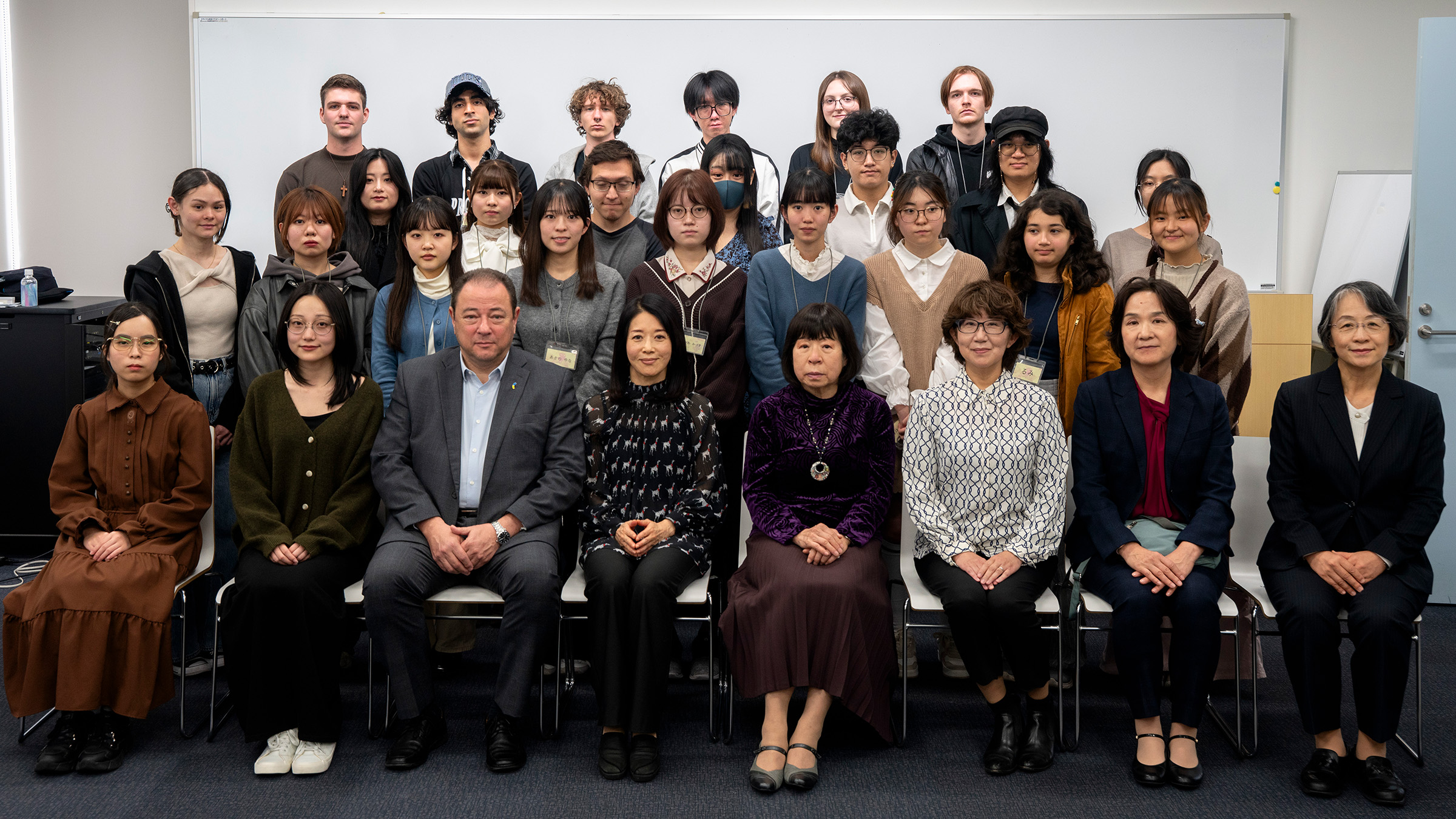
Students and faculty from TUJ and SWU gather for a photo following the Haiku for Peace event. TUJ’s Sergiy Korsunsky (third from left) and poet Madoka Mayuzumi (fourth from left) are seated in the front row.
Students from Temple University, Japan Campus (TUJ) and Showa Women’s University (SWU) came together with TUJ Distinguished Global Scholar and Special Advisor to the Dean, Sergiy Korsunsky, for a special haiku event exploring how the art of the 17-syllable poem can inspire reflections on peace.
Co-hosted by the Department of Japanese Language and Literature at SWU and the Japanese Language Program at TUJ, this joint event has been held almost every year. This year’s gathering took place on November 1, 2025, at SWU, with a total of 26 students from both universities participating.
The haiku workshop was led by Madoka Mayuzumi, an acclaimed haiku poet and SWU’s visiting professor in Japanese Language and Literature Department. TUJ students composed their haiku under the guidance of Associate Professor Asako Yamaguchi, who teaches the intermediate Japanese writing course. During the event, students presented their original haiku and received feedback and commentary from Mayuzumi and an SWU professor serving as co-reviewers. With the theme “Haiku for Peace,” the event offered students an opportunity to reflect on piece through the art of haiku.
This marks the fourth joint haiku workshop between TUJ and SWU since its launch in 2022. For many TUJ students, most of whom are non-native speakers of Japanese, the event provided a first opportunity to compose haiku and to engage with Japanese aesthetics and culture. Mayuzumi, known for her commitment to promoting peace through poetry, began this initiative in 2022 following the outbreak of the war between Russia and Ukraine, using haiku as a bridge for dialogue and empathy across cultures.
Military Conflict Continues
Mayuzumi expressed her deep concern that military conflicts continue to persist around the world, including the ongoing violence between Israel and Palestine and the humanitarian crisis in Gaza. Nevertheless, she continues to promote awareness and reflection on peace through poetry. Her initiatives, she said, offer people an opportunity to contemplate peace by crafting haiku. Mayuzumi and Korsunsky first met when he served as the Ukrainian Ambassador Extraordinary and Plenipotentiary to Japan. During that time, they collaborated on a haiku collection by Vladislava Simonova, a Ukrainian poet who wrote her verses from an underground air-raid shelter in Kharkiv.
Korsunsky recalled that Mayuzumi had visited the Ukrainian Embassy three years earlier, where he learned about her “Haiku for Peace” project. Speaking about Simonova, he said, “She spent six months in a basement in the eastern city of Kharkiv under Russian attacks, writing haiku. We were both deeply moved by her spirit of resilience, it’s hard to imagine the stress she endured, yet she kept writing, and the haiku were truly beautiful. We supported her project, and it took about a year to translate the poems into Japanese and English for publication. I was already familiar with haiku, Japanese culture is highly valued in Ukraine, but I came to realize just how challenging it is to translate haiku from Russian into Japanese while preserving their full essence.”
Amazing Form of Art
Korsunsky described Japan as “one of the most peace-loving countries in the world,” noting that “the desire for peace and harmony can be felt everywhere.” He added that art, such as haiku, serves as “one of the tools that help people endure the tragic realities of war.”
“This is truly an amazing form of art,” he continued, “able to express such deep thought in such a simple structure. Like the students here today, I want to congratulate everyone. I can see the effort and sincerity behind each haiku.”
Korsunsky encouraged the students to continue refining their work and “strive to make their haiku even closer to perfection.” He reflected on the importance of creativity and culture during times of hardship: “Culture gives people the strength to survive in war. It is what distinguishes us as individuals and at the same time, it is what unites us.”
Other related stories
- TUJ Leverages Longstanding Experience to Co-Organize Successful Young Trilateral Leaders Summit (August 13, 2025)
- TUJ Strengthens Ties with India’s Top University through Custom Summer Program in Tokyo and Kyoto (August 7, 2025)
- Temple’s Academic English Program Deepens Collaboration with Showa Women’s University, Strengthens Domestic Partnerships (August 6, 2025)