
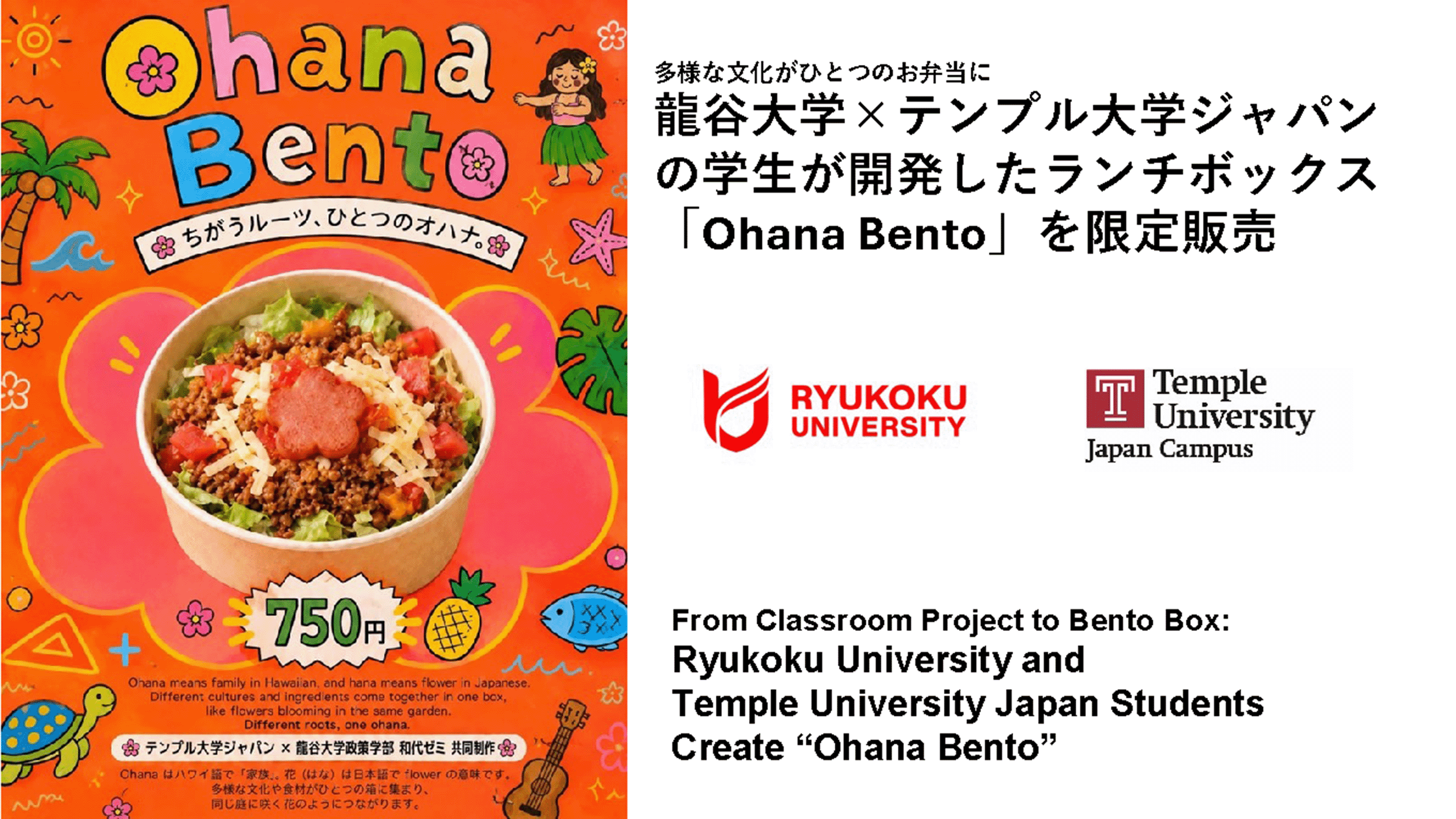
Student-developed lunch debuts at Ryukoku University’s Fukakusa Campus October 19–21
Key points
- A joint classroom project connecting Professor Kazuyo Murata’s seminar at Ryukoku University with TUJ’s Intercultural Communication course has led to a student-developed product.
- Students from both universities formed mixed teams to plan and develop lunch boxes blending different food cultures, in collaboration with Café CØ.
- By turning classroom ideas into a product for the community, the project puts intercultural understanding and practical learning into action.
Students from Ryukoku University and Temple University Japan (TUJ) have turned a classroom project into “Ohana Bento,” a boxed lunch inspired by different food cultures. Developed through a joint intercultural learning project and brought to market with local café, the bento will be sold at Ryukoku University’s Fukakusa Campus on October 19, 20 and 21, 2026. Sales will be limited to 25 lunches per day, with regular sales planned to begin in November.
The project connected Professor Kazuyo Murata’s seminar in Ryukoku University’s Faculty of Policy Science with TUJ’s Intercultural Communication course, taught by Professor Satoshi Toyosaki in Kyoto. Students from both universities formed mixed teams to study intercultural communication and develop lunch concepts that brought together different culinary traditions.
Over approximately two months, the teams developed original menus around the theme of intercultural exchange through food. At their final presentations, they proposed distinctive lunch boxes reflecting a range of cultures and values. The highest-rated team’s idea became Ohana Bento with the support of Ryuhei Yano, a graduate of Ryukoku’s Faculty of Policy Science and the owner of Café CØ.
By working with a local business to turn their ideas into a product, students applied classroom learning beyond the university. The project shares the results of their collaboration with the community and aims to spark conversations about different cultures and perspectives.
Intercultural collaborative learning brings students from Japan and other countries together to deepen intercultural understanding through dialogue and teamwork while addressing real-world challenges.
Sales details
Dates and time: October 19, 20 and 21, 2026, from 12:15 to 1:15 p.m., or until sold out
Location: In front of Tokokan (灯炬館) at Ryukoku University’s Fukakusa Campus, Kyoto
Product: Ohana Bento taco rice; limited to 25 lunches per day
Price: ¥750 including tax
Planning and development: Professor Kazuyo Murata’s seminar, Faculty of Policy Science, Ryukoku University, and Temple University Japan undergraduate
Production and sales: Café CØ
NOTE Project representatives expected on site October 20
Ryukoku University Professor Kazuyo Murata, TUJ Professor Satoshi Toyosaki and students from both universities and Cafe CØ owner Ryuhei Yano are expected to be on site on Tuesday, October 20. Attendance is subject to change.
About Ohana Bento
The name combines ohana, the Hawaiian word for “family,” with the Japanese word ohana, meaning “flowers.” It expresses the idea of people from different cultures and backgrounds connecting and blossoming together. The bento reflects a wish to bring people, cultures and memories together, creating warm, family-like bonds wherever people meet.
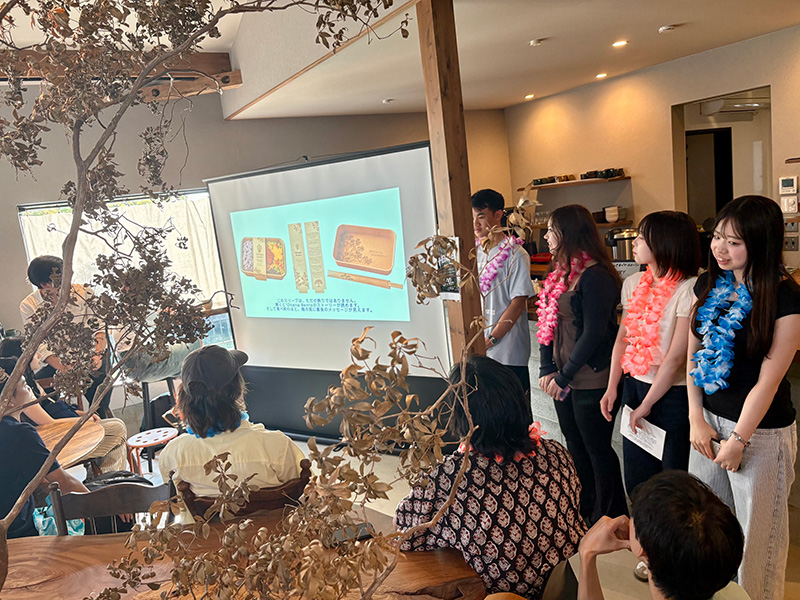

Faculty and student comments
Kazuyo Murata
Professor, Faculty of Policy Science, Ryukoku University
“In this collaboration, students engaged in project-based learning while also reading course texts and studying intercultural communication theory in each class. It was truly an example of intercultural collaborative learning that bridged theory and practice. I am grateful for our connection with Temple University and hope we can deepen our collaboration further.”
Aoi Sasaki and Koto Takeuchi
Students, Faculty of Policy Science, Ryukoku University
“We’re so happy to see our team’s idea come to life and to be able to share it with everyone. We created this bento together with TUJ students, exchanging ideas and respecting each other’s cultures and perspectives. We put a lot of thought and care into it, and we hope it brings people closer to cultures they may not often encounter in everyday life, sparks new discoveries and conversations, and creates opportunities for intercultural exchange. Please give it a try!
Satoshi Toyosaki
Professor, Japanese Program, Temple University Japan
“I had a great opportunity working with Dr. Murata this past summer semester. Seeing our students work together made me realize the limitless potentiality of an intercultural collaborative pedagogy (国際共修). Through this approach, all educational participants—not only students but also teachers—emerge as living textbooks while teaching and learning from, with, and for each other. I hope our Ryukoku University-TUJ collaboration partnership will bring many more meaningful learning opportunities for both of our students.”
Isla Luppi
Sophomore, Asian Studies, Temple University Japan
“The multicultural experience enabled us to better understand different cultures and perspectives. My group had people from at least three different countries, and by sharing our interests, communication difficulties, and different ways of doing things, we were able to learn from each other. It was interesting to see how people from different backgrounds approached the same activities in different ways. I also learned that communication is not only about speaking the same language, but also about being open-minded, patient, and willing to understand other people’s perspectives.”
About Ryukoku University
Ryukoku University originated as the educational institution “Gakuryo” set up on the grounds of Nishi Hongwanji Temple in 1639, and has grown into a comprehensive university educating approximately 20,000 students in the fields of Humanities, Sociology, and Natural Sciences, with 10 Faculties, 1 Junior College, and 11 Graduate Schools.
Steeped in history and tradition, the University is at the same time consistently making great strides toward even greater development, in a combined effort to make the institution one that is “open to the world and reaching to the future”.
About Temple University and Temple University Japan
Founded in 1884, Temple University is a public comprehensive research university in Philadelphia, Pennsylvania, USA with approximately 30,000 students. It is recognized for its education, research and community engagement and holds the Carnegie Classification’s R1 designation for the highest level of research activity.
Established in 1982, Temple University Japan (TUJ) is Temple University’s Japan campus and the largest and longest-established branch campus of a foreign university in Japan. TUJ enrolls more than 4,200 students from approximately 100 countries and regions. TUJ Kyoto opened in January 2025 and now serves more than 450 students.
TUJ continues to expand its presence in Japan through undergraduate and graduate programs. It also offers non-degree programs for learners of different ages, supporting English-language education for children and adults and contributing to community development.
Ryukoku University and TUJ signed a Memorandum of Understanding in November 2024 to support educational and academic collaboration and promote multicultural understanding and coexistence.
Temple University, Japan Campus Deepens Expansion into Kyoto with New Partnership
Other related stories
- Beyond the University Classroom: Temple Expands Learning Opportunities Across Japan (August 31, 2026)
- Experience the World in Japan – 80 Osaka Prefectural High School Students Join International Discussions at TUJ Kyoto (August 19, 2026)
- Temple University Japan Expands Full Degree Opportunities in Kyoto for Fall 2026 (May 25, 2026)